

In the heart of Samburu, where tradition and craftsmanship intertwine, Francis has mastered an ancient skill passed down through generations.
As a blacksmith, he forges spears—symbols of protection, warriorhood, and culture. But despite his expertise, life was a constant struggle. Providing for his family was challenging, and making ends meet seemed like an uphill battle. That is, until Kuza Jamii stepped in and changed his trajectory.
Francis recalls his early days in blacksmithing, a skill he learned from his father at the age of ten. “My job was to fan the fire as my father worked,” he shares. “I started by making bells for livestock, then small spears, and eventually moved to crafting full-sized spears.” This skill became his livelihood, but the challenges were many.
Before joining Kuza Jamii, Francis could barely produce one or two spears per week. He struggled to afford raw materials and was forced to make dangerous trips into the forest for charcoal, sometimes encountering wild elephants. “I did all this just to feed my family,” he says. The little money he made barely covered food expenses, let alone school fees or clothing for his four children. His wife, without employment, depended on him entirely.
When Kuza Jamii arrived, everything changed. Francis and his business group underwent training and received financial support. He proposed investing in his blacksmithing business, and his group allocated KES. 15,000 for materials, while the rest of their grant went into goat rearing.
“With the capital, I started making more spears. Before, I had no money to buy materials, but now I can produce more,” he explains. His income grew significantly, and for the first time, he was able to save money. At the Maa Cultural Week, he sold all his spears and earned KES. 30,000. “It was the first time I ever held KES. 10,000 of my own and brought it home,” he says with pride.
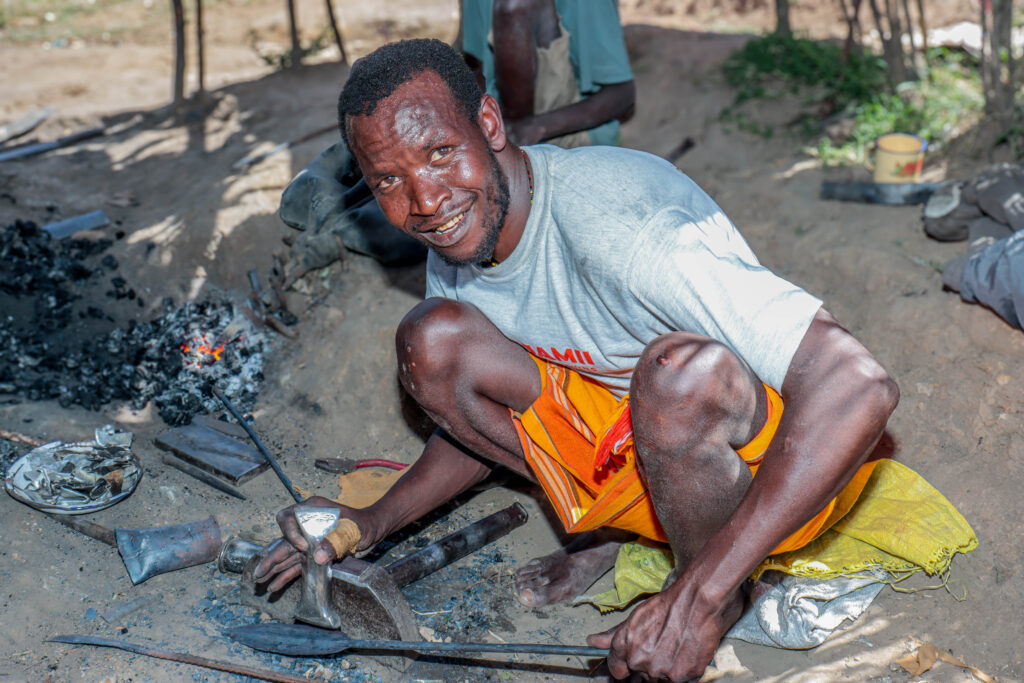
Today, Francis earns at least KES. 4,500 monthly from spears alone, shared equally with his group members. “Before, I never made profits. Now, I can bring money home, buy food, and pay school fees. My children are happy, and I no longer worry about their next meal.”
Kuza Jamii not only provided Francis with capital but also exposed him to new markets. With greater exposure, his phone now rings more frequently as customers place bulk orders and make payments via M-PESA. “People now call me for spears, cattle bells, and even anklets for women. I’ve never had this kind of demand before,” he shares.
Francis also joined a Village Savings and Loan Association (VSLA), where he accesses loans to buy materials for large orders. “Sometimes clients order 20 spears, and I need extra funds. My VSLA helps me with that, and I repay the loan once I sell.” The growth in his business has even allowed him to hire an assistant, a young man who helps him fan the fire, just as he did for his father years ago.
Looking ahead, Francis dreams of expanding his business into a large enterprise. He wants to invest in livestock, ensure his children get a quality education, and continue growing his trade. “I did not get the chance to go to school, but I want to make sure my children do. I want to work hard so that they can have a better future.”
Reflecting on his journey, Francis expresses deep gratitude. “Before, my family barely ate. Now, we have food, and we are happy. Kuza Jamii has changed not just my life, but my entire community. People have something in their pockets, and there are fewer misunderstandings because people can now provide for their families. I hope they will continue doing this so that they even reach more people who have not been reached in this area.”
His words paint a clear picture: poverty is not just about income, but about dignity, stability, and the ability to plan for tomorrow. But as Francis points out, many more families still remain unreached. With continued investment, Economic Inclusion Programs can extend this impact, ensuring that more communities experience the same shift. The ripple effect of these interventions is undeniable; when families thrive, entire communities prosper. Thanks to Kuza Jamii, Francis has gone from struggling to surviving, and now he is thriving.

