Agnes Nairutia, a resilient young woman from Lemsigio sub-location in Poro Ward, Samburu County, knows what it means to struggle and to rise above challenges. Alongside her Business Group partners, Johnson Lolmeweti and Ndorokoya Lolmeweti, she has transformed her life and the lives of her family members through Kuza Jamii, a program that supports the Government of Kenya in progressively taking responsibility for the national Economic Inclusion Program.
Agnes’ journey began long before Kuza Jamii. She first benefited from Inua Jamii, a government-led Economic Inclusion Program, through her late mother in 2006. After her mother’s passing, she was registered as an orphan and continued to receive financial support. With this assistance, she took on the responsibility of raising and educating her four younger siblings. Thanks to her dedication, one sister is now a chef at Samburu Lodge, another is studying at the Kenya Medical Training College (KMTC) in Lodwar, while the youngest two are still in high school.
Before Kuza Jamii, Agnes and her group members struggled to find consistent income. Ndorokoya did strenuous masonry work, Johnson repaired household items, motorbikes, and bicycle punctures and Agnes took up casual jobs whenever she could find them. Life was unpredictable, and meeting basic needs was a daily challenge.
That changed when Kuza Jamii enrolled her in their Economic Inclusion program implemented by BOMA, and five other consortium partners. The program equipped her with crucial financial literacy skills, teaching her how to save, budget, and manage business profits.
Agnes explains, “They taught us how to save money, manage our business money, and share what we earn. We also learned how to budget so we don’t spend carelessly, and how to look at the market before starting a business.” After the training, Agnes and her group, Nenchula, meaning “staying together” first received KES 60,000 to start a business. Though their initial venture, a kiosk, faced stiff competition, they adapted by shifting their focus to beadwork and goat rearing.
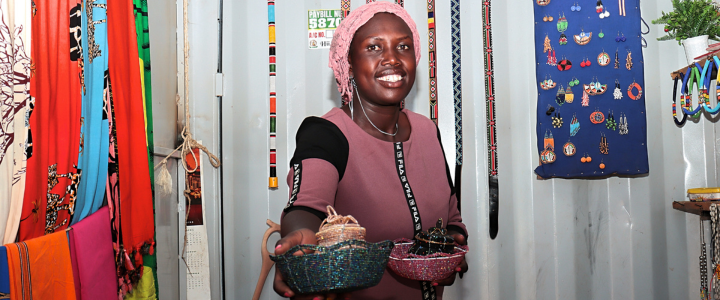
Through careful market assessment and business acumen, Agnes and her team capitalized on seasonal demands. They bought six goats, with the cheapest costing KES 3,500 and the most expensive KES 4,500. They later sold four goats at a significant profit during Christmas, with the most expensive one fetching KES 11,000. Their beadwork business thrived as well, with high-quality beads sourced from Nairobi and sold at cultural events. “There are times when beads are in very high demand, like during the last Maa Cultural Week. We sold necklaces and made a good profit margin,” Agnes explains. Recognizing the value of reinvestment, they used an additional KES 30,000 grant from Kuza Jamii to expand their beadwork enterprise. To maximize earnings, they source some beads locally while purchasing higher-quality ones in Nairobi, where wholesale prices are lower. Fortunately, the Samburu County Government has created a supportive environment for business owners like Agnes. The county has set up stalls where women can sell their beadwork without paying rent. Each stall is shared by three people, providing a secure and affordable space for their businesses.
“I was lucky to find a space where I could sell my beadwork and share with two other ladies. The shops were built by the Women Representative in Maralal. We don’t pay rent, and we trust each other. Whoever opens the shop first can sell for the others because we all know the prices of our items,” Agnes shares.
As part of their financial growth, Nenchula Business Group joined forces with six other business groups to form Koskosi, a Village Savings and Loan Association (VSLA). This structure provided members with a platform to save collectively, access credit, and build resilience against financial shocks.
Today, Agnes and her group no longer rely on unpredictable casual labor. Their businesses are flourishing, providing stable income and lifting them out of poverty. More importantly, their improved financial status has translated into better living conditions.
“Before Kuza Jamii, our living conditions were poor. We could barely eat two meals a day, just breakfast and sometimes supper. But now, everything has changed. If I could show you photos of the three of us before and after the program, you’d see the difference. We’ve all added weight, we’re glowing, and we’re eating well. We never used to have chicken, but now we do. We eat eggs and even make pancakes from the eggs our chickens lay. Our meals are more diverse; we no longer rely on just one type of food,” Agnes shares.
Beyond nutrition, access to healthcare has also improved. In the past, falling sick meant relying on herbal remedies, which sometimes led to long-term health complications because they couldn’t afford hospital visits. But with their participation in the Village Savings and Loan Association (VSLA), they now have a safety net. “Now, if any of us falls sick, we can go to the VSLA and request financial support for medical expenses. Even within our business group, we lend each other money when needed. If I have an issue, I can turn to my group members, explain my situation, and they will support me,” she explains.
Through Kuza Jamii, Agnes and her business partners have built a sustainable livelihood, proving that with the right support, training, and opportunities, economic transformation is possible. Moreover, their success has empowered them within the community. Agnes and her team actively participate in decision-making, demonstrating that women can lead economic transformations at the household and community levels.
Agnes’ ambitions extend beyond business success. She has gone back to school through distance learning to study Community Health Assistance. “I value education so much because right now in this life, without education, you won’t have a competitive advantage,” she explains. “I decided to do community health because many health facilities are coming up, and I see job opportunities. I also want to have a salary at the end of the month so that I can give my children a better life and ensure that my siblings have excelled at what they do.”
er vision also includes securing a better future for her siblings and ensuring her own children receive a quality education. “I have agreed with my children that if they work hard, whatever high school they are called to, I will ensure they go there and study. I will try as much as I can to ensure that they go to the best boarding schools. I want our lives to change. I want my siblings and I not to look like orphans but like people who have both parents. We want to have the same opportunities as those with parents.”
Agnes and her Business Group Members are also determined to see Nenchula thrive beyond Kuza Jamii. “Even after the program, we want to ensure that we continue even 10 years from now. Our aim is that every member of our group adds five goats each on top of what we have. We want to look at our goats and say that we have them as a result of the Nenchula Business Group.”
Thanks to Kuza Jamii, Agnes’ story is a story of growth, dignity, and hope. With increased income diversity, savings, and access to financial support, she and her business partners have built a sustainable livelihood. Their journey demonstrates the lasting impact of economic inclusion programs in transforming lives.
“We are no longer poor. Our children are now going to school. We have businesses we can depend on, and we can plan for the future,” Agnes says with pride. Through Kuza Jamii, communities like hers are thriving, proving that with the right support, training, and opportunities, economic transformation is possible for all.