

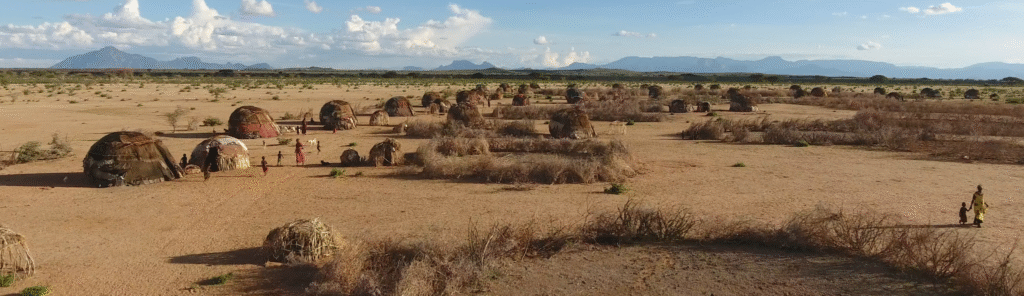
Aerial view of a rural community in Africa’s drylands. © BOMA
On the International Day for the Eradication of Poverty, the evidence from Africa’s drylands points to important questions. What helps people move out of extreme poverty? What makes that progress last? What needs to happen around them for it to continue?
824 million is a difficult number to comprehend. It is roughly one in ten people worldwide living in extreme poverty, according to the World Bank’s latest global poverty update. Seven in ten of the world’s people living in extreme poverty are in Africa. A decade ago, that share was four in ten. The numbers are stark, but they sharpen the question before us: what do we actually know about helping people move out of extreme poverty and stay out of it?
The International Day for the Eradication of Poverty, marked every October 17, gives us a reason to ask that question seriously. This year’s UN focus, “Safe Homes for All,” reflects a wider truth. Income, food security, housing, health, education, dignity and participation are closely connected.
That reality is especially visible across Africa’s drylands, where many communities live far from formal markets, financial services, infrastructure and economic opportunity. These are often described as “last-mile” communities, places where investment and services can reach people late, if at all.
The idea of “graduating” from poverty can sound abstract. There are no caps, gowns or ceremonies. In practice, graduation is measured through the everyday changes that help a household build greater security, resilience and choice.
“There are no caps, gowns or ceremonies.”
At BOMA, that progress is assessed through practical indicators. Can everyone in the household eat at least two meals a day? Has the participant built savings and gained access to credit? Does the household have more than one source of income? Is the participant increasingly able to take part in decisions at home and in the community?
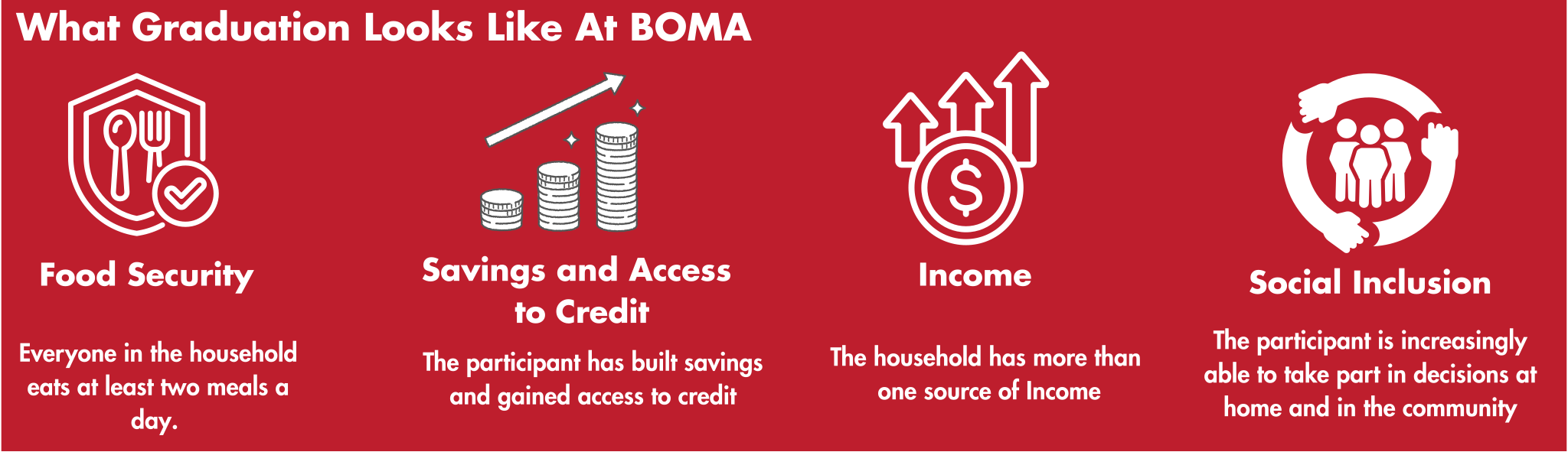
BOMA assesses progress across these four areas. Participants must meet the first three outcomes to reach the graduation threshold.
BOMA assesses progress across food security, savings and access to credit, income, and social inclusion. Participants must meet the first three outcomes to reach the graduation threshold. The word participant is deliberate. People may lack formal business knowledge or capital, but they bring local knowledge, judgment, relationships and the willingness to work.
Miriam Lekolo’s story makes that real. After losing her husband, she supported her family by brewing chang’aa, a locally produced illicit alcoholic drink, in Nengerpus, Samburu County. It was dangerous and unstable work, but one of the few income options familiar to women around her.
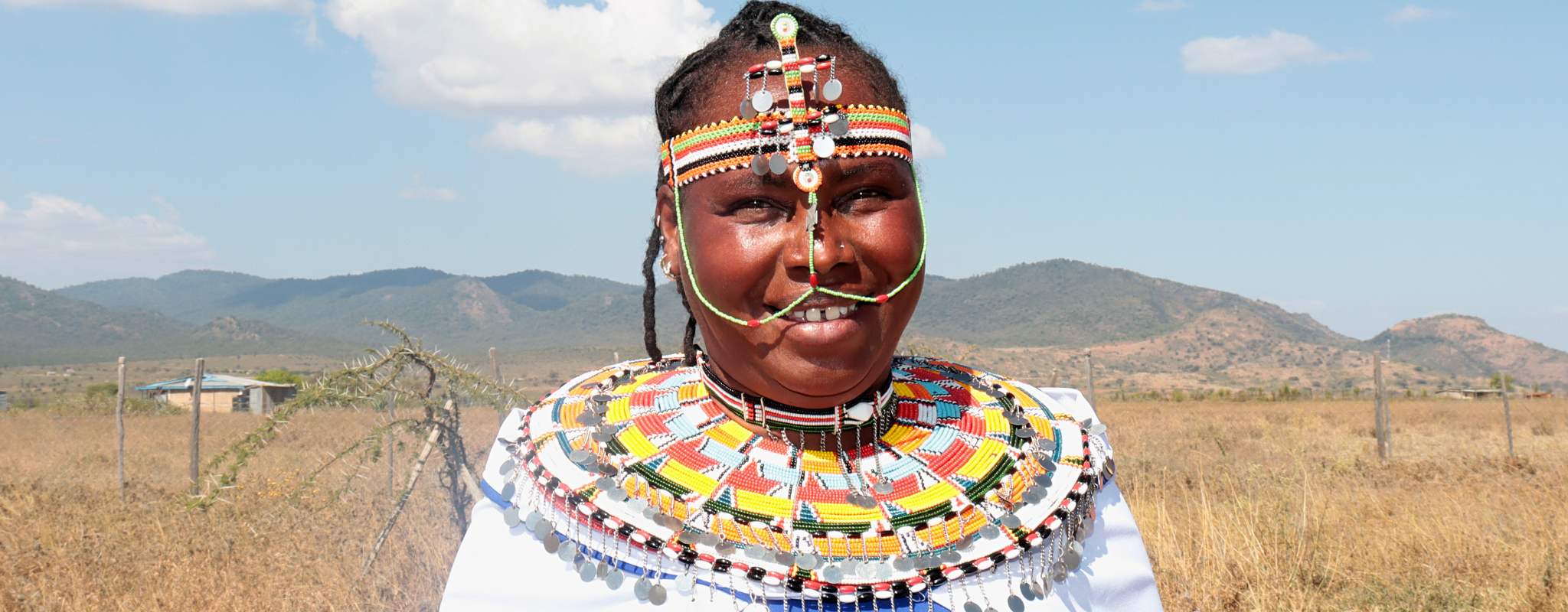
Portrait of Miriam Lekolo wearing traditional beadwork in a dryland landscape in Samburu County, Kenya.
When Miriam joined BOMA, she and two other women formed the Namayana Business Group. They learned how to run a business, save and reinvest, then began selling everyday goods such as sugar, salt and cooking oil. A mentor continued to guide them as they put what they had learned into practice.
That sequence is central to BOMA’s Rural Entrepreneur Access Project (REAP), our flagship poverty graduation model. Participants begin with business training, assess their local markets, identify viable opportunities and develop business plans before receiving capital to start their enterprises. Training continues as businesses grow, covering practical skills such as cash flow, pricing, record keeping, credit, customer service, saving and investment.
The support around the capital matters just as much. Mentors provide monthly coaching and hands-on guidance as participants work towards graduation. They come from the communities where participants live, understand local markets and realities, and communicate in locally understood languages and dialects. Participants have different levels of formal education and literacy, so business concepts cannot depend only on written manuals. Financial literacy should not depend on literacy alone; cash flow, pricing, credit and profit need to make sense in a real business.
“Financial literacy should not depend on literacy alone.”
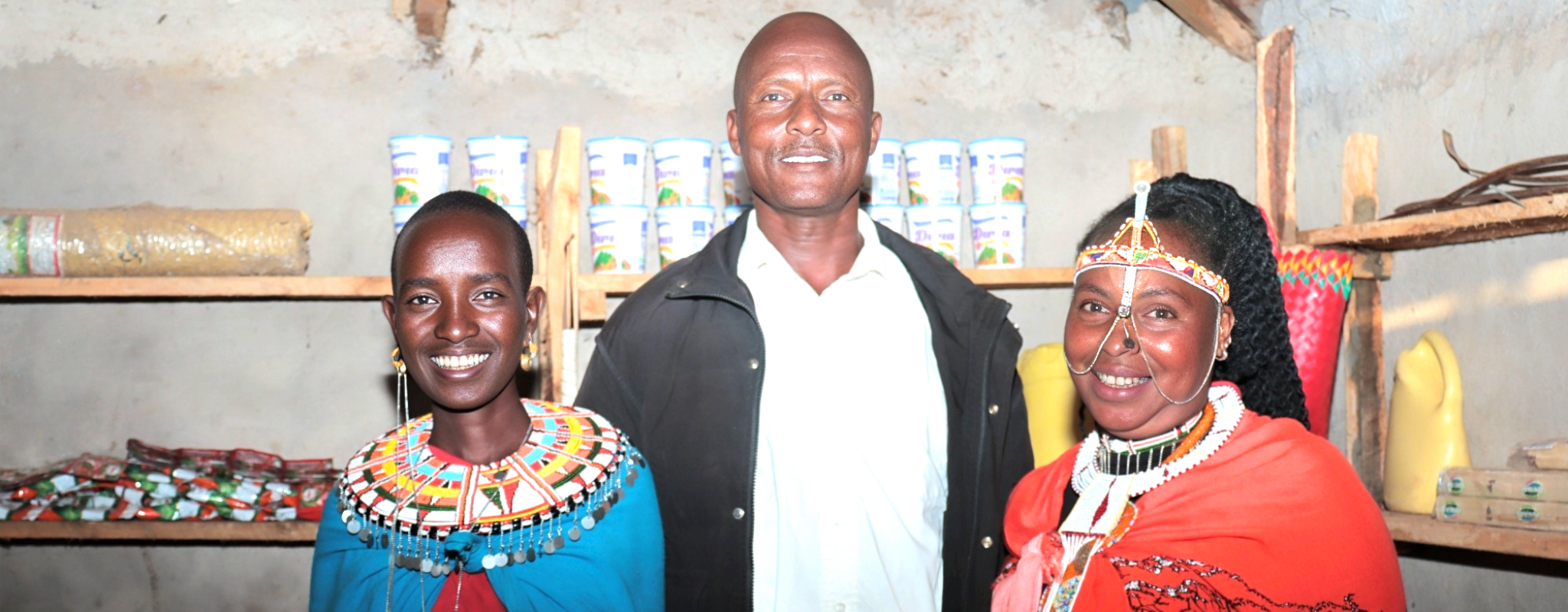
Miriam Lekolo, their mentor (centre), and her business partner in their shop in Samburu County. BOMA mentors provide monthly coaching in locally understood languages. © BOMA
Stories such as Miriam’s show what change can look like. Evidence tells us whether that change extends beyond one person.
A randomized evaluation led by UC Davis, with the International Livestock Research Institute and BOMA as partners, found that women completing the 24-month REAP program had, on average, 324% more business assets, 32% more annual household cash income and 509% more cash savings than women in communities where REAP was not offered. The study estimated roughly three dollars in benefits for every dollar invested.
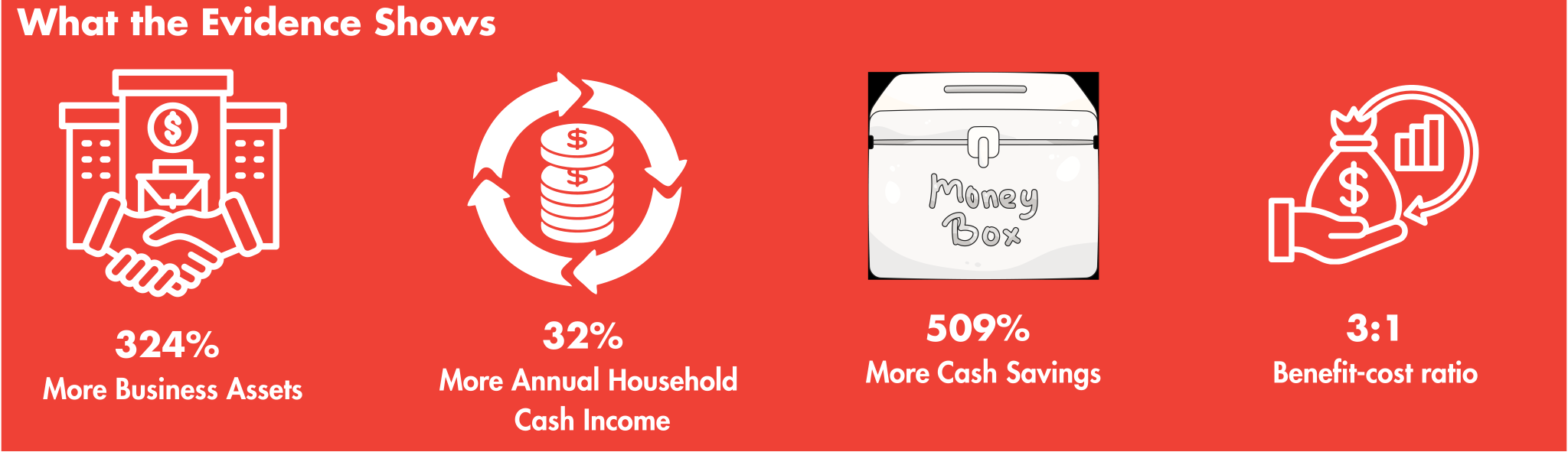
Randomized evaluation led by UC Davis
The next question is whether those gains last. BOMA’s longitudinal assessment found that three to five years after graduation, 81% of participants were still operating a business. Household savings had increased by 78%, while the share of children going to bed hungry had fallen from 40% at baseline to 13% at follow-up.
Miriam’s experience gives those findings a human shape. As the Namayana Group’s savings grew, the women used almost KES 20,000 to help intervene when the 12-year-old daughter of one group member had been forced into child marriage. They supported her return to school. Today, she has completed Form Four, earned a strong grade and hopes to become a nurse and build a better future for her parents. [Watch Miriam and the young woman they supported share what happened in their own words.]
Her influence later travelled further. Miriam recruited ten women who had never participated in BOMA’s program into her savings group and mentored them in business. Some had previously brewed chang’aa, while others had relied on cutting trees for charcoal and firewood.
“I have recruited 10 women who were not BOMA participants into our Savings Group. I have mentored them… They are all in my Savings Group and they all run successful businesses,” she says.
The woman who once received mentorship became a mentor herself, keeping knowledge in the community. A savings group established through one intervention became a place where other women could learn, save and build livelihoods of their own.
BOMA has also continued testing how REAP can respond to different realities. A recent randomized evaluation led by Innovations for Poverty Action, in collaboration with Northwestern University, Oregon State University and the London School of Economics and Political Science, compared Standard REAP with Green REAP across 105 communities in Marsabit, Samburu and Turkana. Both approaches produced large, statistically significant improvements in household well-being. Green REAP, which adds environmental and natural-resource components to the core model, maintained the poverty-reduction gains of Standard REAP while producing stronger results on several measures of food security, productive assets and environmental practices.
The study found that both approaches increased business ownership, profits and savings, while Green REAP also reduced charcoal and fuelwood production and increased sustainable livestock and environmental management practices. The researchers found no evidence that environmental objectives required sacrificing poverty-reduction outcomes.
The same principle of adaptation applies across BOMA’s work. A young person entering the labour market faces different barriers from a refugee rebuilding a livelihood after displacement. BOMA has adapted REAP for youth, refugees, nutrition, climate resilience and government delivery while retaining the model’s core elements.
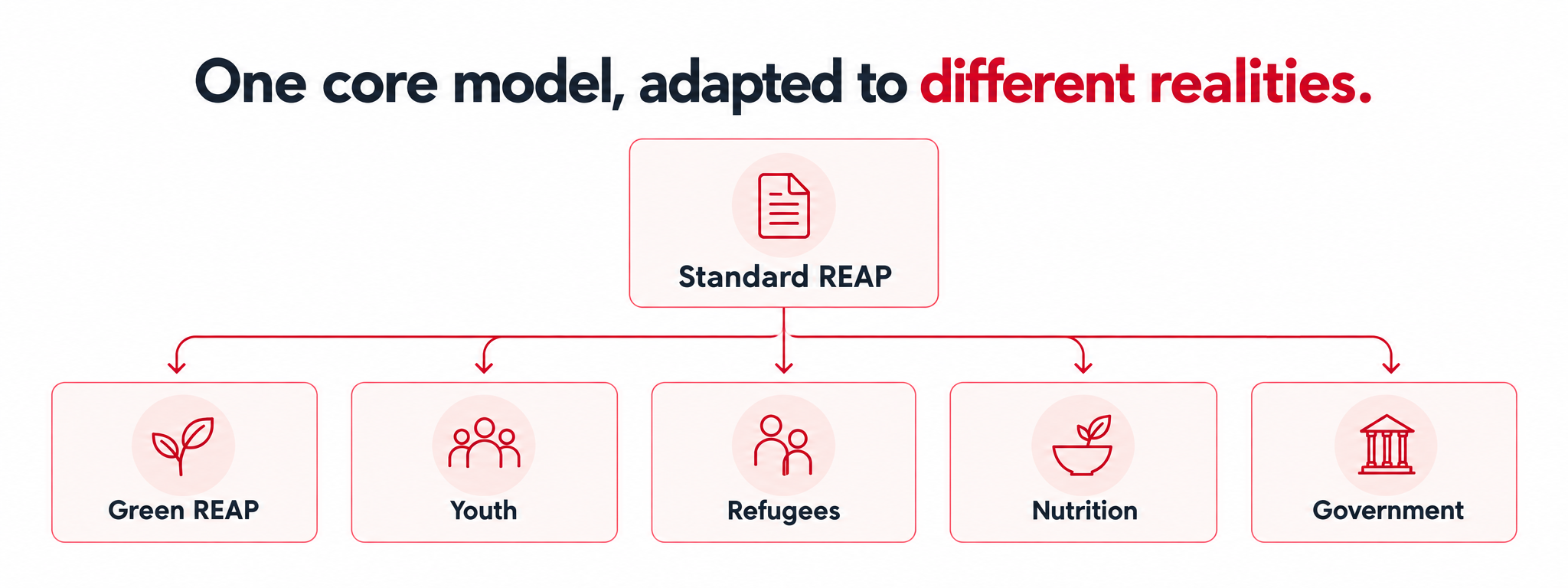
BOMA’s REAP model has evolved to meet different needs while retaining its core graduation approach
Sustainability also has to work at scale. Through Kuza Jamii (Transforming Communities), part of the Government of Kenya’s Hunger Safety Net Programme Phase 3, BOMA worked with government structures to complement social protection with economic inclusion approaches. Across two phases in eight counties, Kuza Jamii reached 17,054 participants and generated practical learning on how vulnerable households can build more sustainable livelihoods.
This is central to REAP for Government. Long-term scale cannot depend on BOMA implementing every program itself. Government has the mandate, systems, data and reach to take proven approaches much further, while BOMA can contribute technical expertise, implementation experience and evidence.
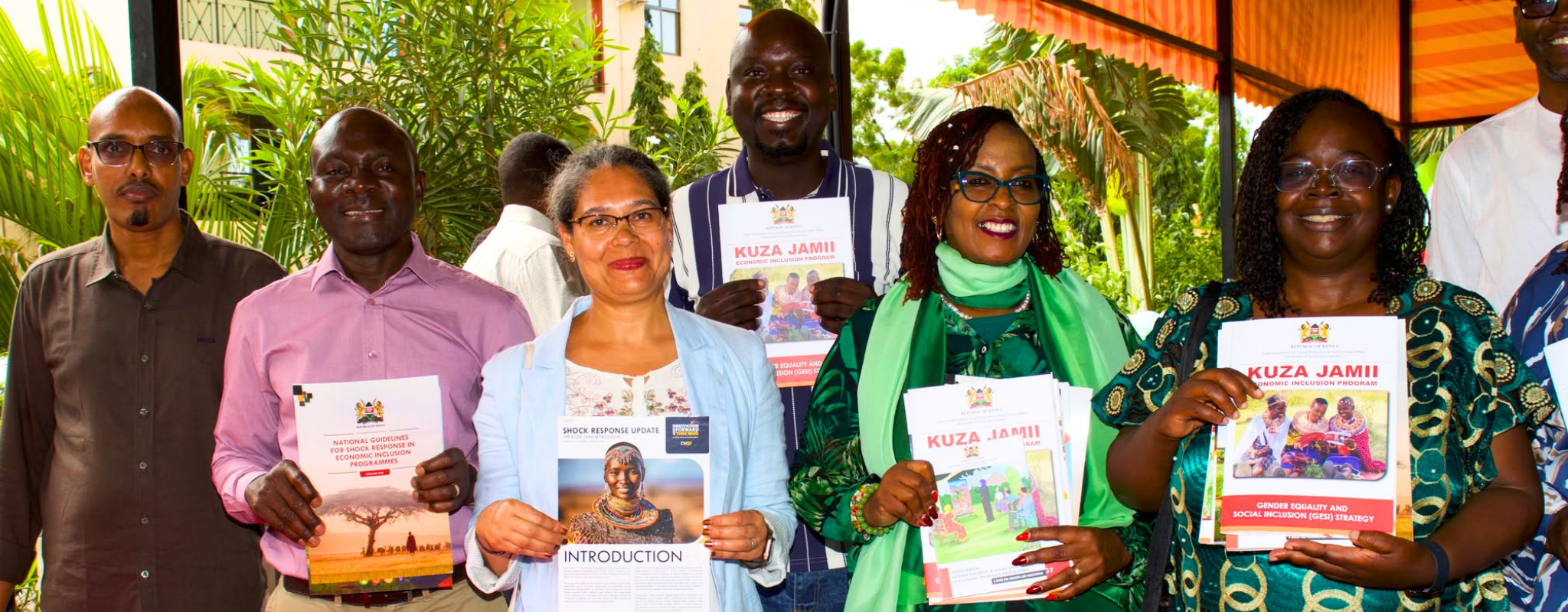
Symbolic handover of Kuza Jamii in Wajir County, marking the transition to full government-led implementation of Economic Inclusion Programs. © BOMA
Sustainability can therefore look different at different levels. In Miriam’s community, it looks like one participant mentoring ten other women. At program level, it looks like locally recruited mentors keeping knowledge close to the people they serve. At national level, it can mean government systems carrying proven approaches to many more households.
More than 1.3 million lives have been impacted through BOMA’s work since 2009. Reaching millions more will require scale, continued adaptation and stronger systems around the people building their livelihoods.
There is a point where individual effort meets barriers one entrepreneur cannot solve alone. Miriam can run a business, save and reinvest. She cannot build the road that connects her to a larger market, design a financial product for remote entrepreneurs or create the policies that influence whether companies invest there.
“There is a point where individual effort meets barriers one entrepreneur cannot solve alone.”
A 2026 Columbia University School of International and Public Affairs (SIPA) Capstone study, conducted in partnership with BOMA, describes this as a “structural ceiling.” Household-level progress can be constrained when markets, financial services, buyers and the policy environment do not develop alongside it. The same research estimated about $11.9 billion in annual household expenditure across the wider BOMA-active geographies it studied in Kenya, Ethiopia and Uganda. That figure is not income generated by BOMA. It points to economic activity and demand in places frequently viewed only through poverty and vulnerability.
A financial institution may see potential customers but lack reliable information about remote communities. A buyer may see opportunity but struggle to reach enough producers. Government brings public systems and scale. Private companies bring markets, technology and capital. Donors can provide patient funding for evidence, partnerships and testing new approaches. Locally led organizations such as BOMA can help connect those pieces.
Funders should continue asking whether incomes increase, businesses survive, assets grow and households save. BOMA should be willing to answer the same questions. We should also ask what happens five years later. Can participants access larger markets and finance? Are gains equitable? Can governments take proven approaches to scale? Can private-sector partners reach communities that have historically sat outside formal markets?
Good evidence tells us where progress is real and where the work remains unfinished.
The scale of extreme poverty should make us impatient. The evidence gives us reason to keep going. We know more today about what works at household level, we are learning more about what makes those gains last, and we have a clearer view of what needs to happen around participants for progress to continue.
That wider view also brings us back to the purpose behind the work. Income matters, but so do food security, education, choice, participation and the ability to plan for the future. For BOMA, Rural Entrepreneurship for Prosperity with Dignity is what this looks like in practice. It means building livelihoods that give people greater agency over what comes next.
“The people living furthest from opportunity should not also be the furthest from investment.”
The people living furthest from opportunity should not also be the furthest from investment. BOMA is ready to work with donors, governments, private-sector partners and others who want to take proven approaches further and expand economic opportunity across Africa’s drylands.
Interested in partnering with BOMA? Let’s explore how we can take evidence-led approaches further. Contact us at info@boma.ngo

