Draw a cow on a flip chart. Now identify at least 40 ways to earn from it.
At first, the task might seem difficult but think about everything that happens before an animal reaches the market or its products reach a customer. Someone produces its feed, provides veterinary services, transports it, processes its products or connects traders to buyers. Similar opportunities exist in poultry, from hatcheries and egg production to feed supply, processing and marketing.
This exercise, part of CASHA’s PI-Agripreneurship training led by the Food and Agriculture Organization of the United Nations (FAO), encourages young people to look beyond familiar activities, recognise unmet needs and identify opportunities to earn an income.
That shift matters in Kenya’s arid and semi-arid lands, where livestock has supported families for generations. Growing up around livestock, however, does not automatically mean having the resources or opportunity to earn an independent income from it.
For young women, the barriers can be particularly complex. In many pastoral and agro-pastoral communities, women contribute to livestock care and household livelihoods while having less control over ownership, sales and income decisions. These realities vary between communities, but they raise an important question about who gets to participate in the livestock economy and benefit financially from it.
Through Creating Shared Value with Young People in the Livestock Sector (CASHA), young people are being supported to recognise and pursue these opportunities. Funded by the Mastercard Foundation, CASHA is implemented by a consortium led by FAO, alongside BOMA, SNV, the International Livestock Research Institute (ILRI), the Kenya Livestock Marketing Council (KLMC) and E4Impact.
As part of this partnership, BOMA is adapting its Rural Entrepreneur Access Project (REAP) approach to support young people through entrepreneurship training, mentorship, savings, financial inclusion and connections to markets.
This is the first in a series following how young people put these opportunities into practice, the challenges they encounter and what we learn as their journeys unfold.
Some participants are receiving productive assets through the CASHA Challenge Fund, including goats, poultry and other approved business inputs. These assets are intended to help participants establish or expand enterprises, with opportunities to earn income and reinvest in their businesses.
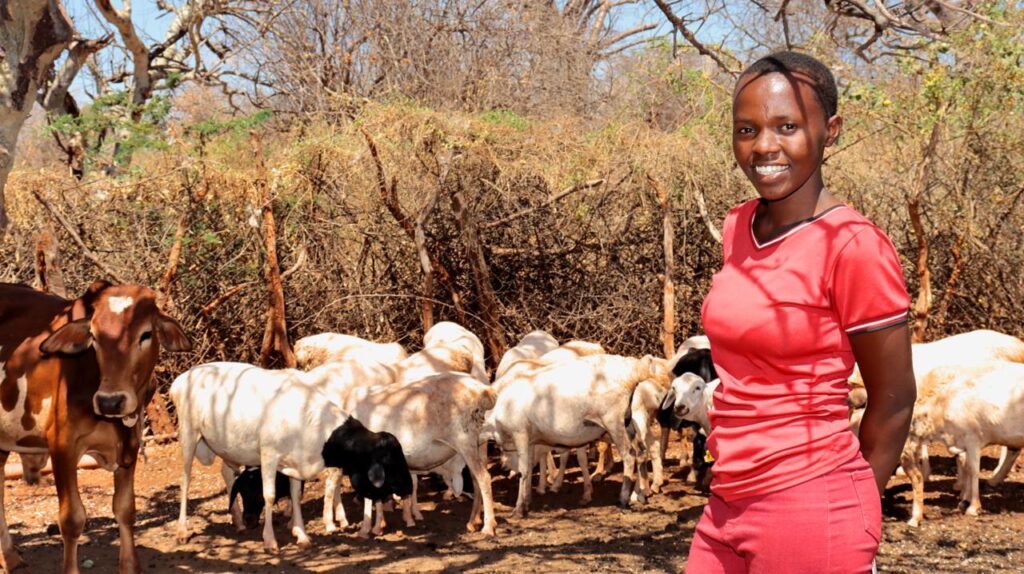
For Angela Mbinya Peter, from Kathonzweni Ward in Makueni County, receiving four Galla goats has given her a starting point for a business she hopes to grow.
I received four Galla goats from CASHA through BOMA. I am very happy. I plan to fatten them and sell them at Kathonzweni Market. After each sale, I want to buy smaller goats to fatten and sell again. In future, I would like to have at least 20 goats so I can support my family and my poultry business as well.
Angela Mbinya Peter, Kiluluini training group, Itumbule, Kathonzweni Ward · Challenge Fund recipient.
Angela is already thinking beyond her first sale. Her plan is to reinvest what she earns, gradually build her livestock business and support her family. Whether she achieves that ambition will depend on how her enterprise develops, but she has a clear idea of what she wants to work towards.
Her experience represents one pathway into entrepreneurship. Most young people supported through BOMA’s contribution to CASHA will follow another.
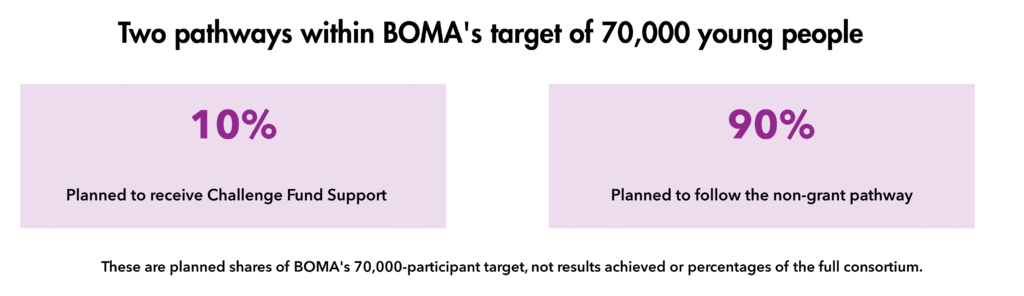
For young people who will not receive direct grants, the programme is focused on building entrepreneurship skills, encouraging savings, providing mentorship and helping participants explore other ways to access financing.
Halima is one of those participants. She did not receive Challenge Fund support, but she describes how training and help from her family contributed to her business journey.
CASHA has helped me. I learned how to start and run a business. When I started, I had nothing. I borrowed a sheep from my brother, and that helped me start. I now have three goats, and I know how to keep records to see my profits and losses. I am very thankful to CASHA.
Halima, CASHA participant, Isiolo · Non-grant pathway
Halima’s experience offers another perspective on how young people can begin pursuing business opportunities. She started with an animal borrowed from her brother and says the training helped her understand how to run a business and track its performance.
Through CASHA’s training groups, participants are developing business and financial management skills, building savings habits and exchanging ideas. As groups accumulate savings, members may also be able to access loans to establish or strengthen enterprises, depending on available resources and lending arrangements.
BOMA is also working to connect participants with cooperatives, SACCOs, financial service providers and public financing initiatives such as the Uwezo Fund, giving young entrepreneurs options to explore additional sources of capital.
The FAO-led PI-Agripreneurship training encourages young people to identify customers, understand market demand, calculate costs and make informed business decisions. A young person interested in poultry farming might initially think only of raising chickens. Looking more closely at the wider value chain could reveal opportunities in feed supply, hatcheries, egg distribution, processing or transportation. Similar possibilities exist in livestock trading, fodder production, butcheries and agricultural services.
Still, recognising an opportunity does not guarantee that a business will succeed. Limited access to suitable financing, unreliable markets, drought, animal diseases, transport costs and changing prices can affect whether an enterprise becomes profitable. Young women may face additional challenges in accessing resources and controlling business income.
This is why CASHA’s partnerships with financial institutions, technical service providers, buyers and other market actors matter. The aim is to help young people move from identifying opportunities to developing businesses that can generate income.
For BOMA, the ambition is to support 47,000 of its targeted 70,000 participants into dignified and fulfilling work by 2030, with a target average monthly income of KES 17,500.
Angela and Halima offer an early glimpse into two different routes towards that ambition. One received productive assets through the Challenge Fund. The other began with an animal borrowed from a family member and knowledge gained through training.
Their experiences are encouraging, but their journeys are still unfolding. As CASHA progresses, we will return to the questions raised in this first story. How are participants putting their skills into practice? Are their businesses growing and generating reliable incomes? What challenges are they encountering? And how do the experiences of participants who receive grants compare with those who do not?
We will continue sharing participants’ experiences alongside emerging programme evidence, including successes, setbacks and lessons that help us understand what is working and what needs to improve.
This is the beginning of the story. The chapters ahead will show what young people are able to build, how their businesses develop and what CASHA can teach us about expanding economic opportunities across Kenya’s drylands.